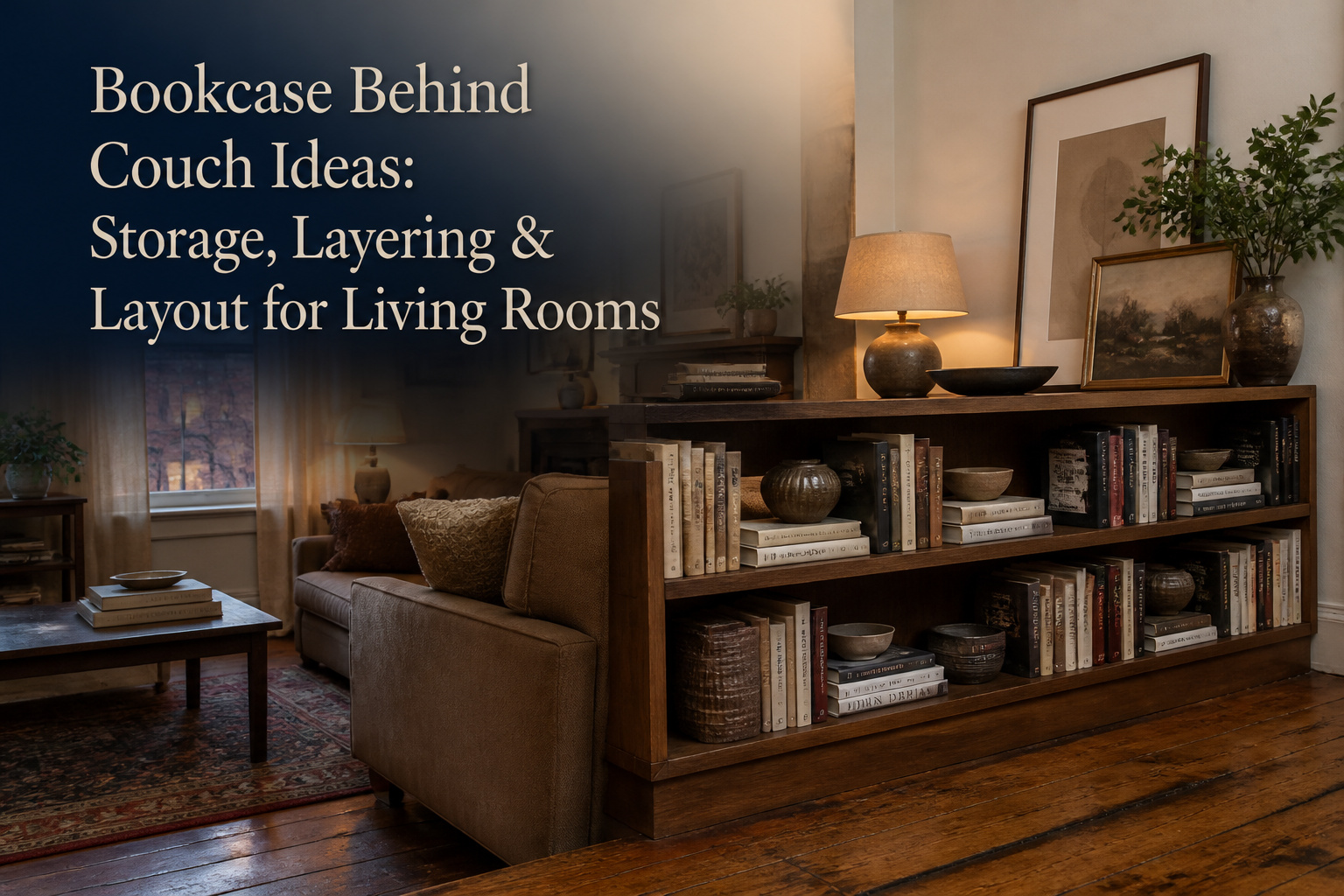
A bookcase behind the couch is a storage wall that borrows depth from behind your seating instead of floor space you do not have. It only works if you accept that anything below the sofa back becomes quarterly storage, not daily. In a 1,060-square-foot Philadelphia row home, six shelves wedged behind a sofa turned dead air into the room’s only usable vertical real estate, with the top third rising clear to carry lamps and framed prints where a gallery wall could never hang.
Bookcase as a Decorative Element

The back of a couch faces a wall for years before you notice it’s basically a billboard you never filled. Mine sat there, beige and blank, until I walked through a friend’s narrow row house in Philadelphia and saw exactly what that dead space could carry.
She’d wedged a six-shelf bookcase behind her sofa, not because she planned it that way, but because the unit she’d found was too big for anywhere else. The lower shelves held board games and off-season blankets, tucked out of sight. The top two shelves, though, rose clear above the couch back and carried framed prints, a small brass lamp, and a ceramic bowl she’d picked up at a flea market. The bookcase became the room’s focal point without needing a single nail in the wall.
The height matters. A six-shelf unit gives you roughly the top third above typical sofa backs, which is where the eye lands first. Keep the display light, a few objects with breathing room between them, and the arrangement reads as intentional rather than leftover. Books spine-out work fine, but alternating stacks with objects facing forward breaks the grid. I tried a row of matching frames once and it looked like a waiting room. A single leaning piece, a small plant, nothing too precious, reads warmer from across the room.
The tradeoff is real: anything below cushion level is for storage you access quarterly, not daily. But for a renter who can’t hang a gallery wall, or anyone whose couch faces the door, the back-of-sofa bookcase turns the least interesting view in the room into the one people comment on.
Recommended Products

Ample Storage Space: Come with 4 open shelves, the shelving unit provide plenty of room for holding and displaying your books, photo frames, decorations and etc
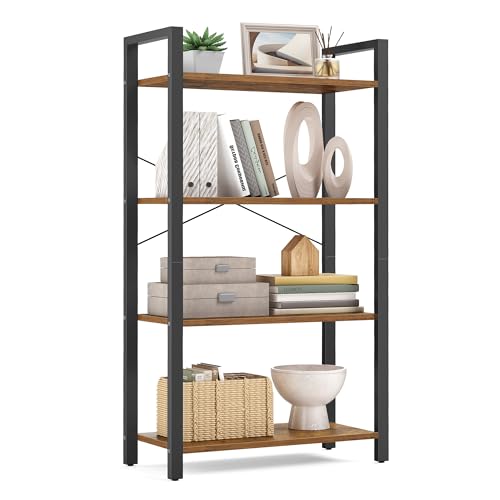
Space-Saving for Any Room: This 11.8"D x 26"W x 47"H bookshelf occupies little floor space yet offers you 4 tiers of vertical storage, making full use of the small spaces in your living room, bedroom, bathroom, or entryway
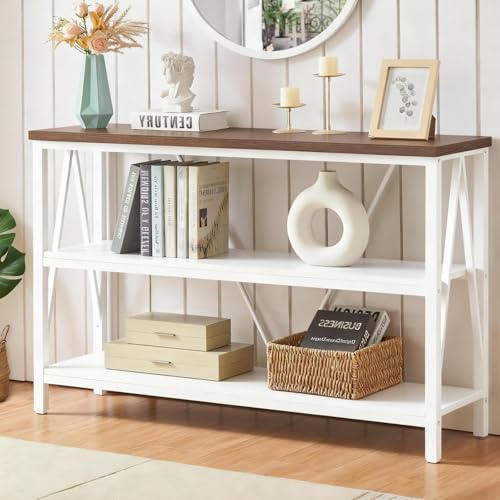
3 tier Entryway Console Table: The industrial sofa table is made of sturdy metal frame and chunky wood-grain MDF panels, perfect for displaying lots of things like books, decorative plants and framed photos; it will add a warm atmosphere to your entrance, and you can place the modern console table with storage for living room as a display table.
Storage Solution

A bookcase behind the couch turns dead space into real storage, but only if you layout the shelves by how often you reach for things. In my 1,060-square-foot townhome, the living area is narrow enough that the back of the sofa sits almost against the wall with maybe a foot of clearance. I learned the hard way that daily-use items belong on the top two shelves, not down below. I kept my journal, current read, and the TV remotes on the bottom shelf at first, which meant bending behind the couch or sliding the whole thing out every single time. The lower shelves are better for board games, extra cables, or that stack of magazines you swear you’ll get to, because kneeling down once a month is fine. Knocking something over with your shoulder while you grope for the remote is not.
Recommended Products

Side Table for Small Spaces: Our side table is just 7.08in wide and is designed for small Spaces. The narrow desk body is perfect for small areas between chairs and sofas or other limited Spaces, helping us make the most of every inch of space

Side Table for Small Spaces: Our side table is just 7.08in wide and is designed for small Spaces. The narrow desk body is perfect for small areas between chairs and sofas or other limited Spaces, helping us make the most of every inch of space

Multifunctional and Stylish: Whether you choose to use this in your living room as a console table, spare bedroom as a wood console, study room as a bookshelf or dining room as a buffet, this vintage sofa table will make a stylish and practical addition to your home.
Layering Furniture

A small, dark living room in a row home leaves you with a brutal choice: pull the sofa off the wall and lose two feet of floor you do not have, or push it flat against the drywall and stare at blank paint. Layering the bookcase behind the sofa fixes both. The piece still reads as wall-adjacent, but it earns you six shelves of storage in a footprint that was already spoken for.
Bryce and Stefan’s 1920s Philadelphia row home runs front-to-back, staircase cutting straight through, and the living room sits narrow enough that standard furniture spacing eats the whole floor. The bookcases they found on Facebook Marketplace were too big for the wall they’d planned. Behind the sofa was the only spot left, and it turned out to be the right one. The shelves hold what they need within reach up top, and what they rarely touch down where the sofa back blocks access.
What reads like a compromise becomes the layout. The bookcase gives the sofa a visual back instead of a wall, and the top surface carries art or lamps where a gallery wall would have hung. In a long, narrow plan that does not allow for side tables on both arms, that rear shelf line is often the only usable surface in the room.
Recommended Products

Small Bookshelf for Small Spaces: Featuring a compact design, the floor standing tree bookshelf optimizes floor space, making it an excellent choice for bedrooms, home offices, corners, hallways, or smaller living rooms. This narrow small bookcase organizer provides ample storage for books, CDs, game cassettes, decorations, and more. Keep your belongings stylishly organized, ensuring a neat and clutter-free space. ( Book shelf dimensions: 47.4"H*14.6"L*"7.9"W )
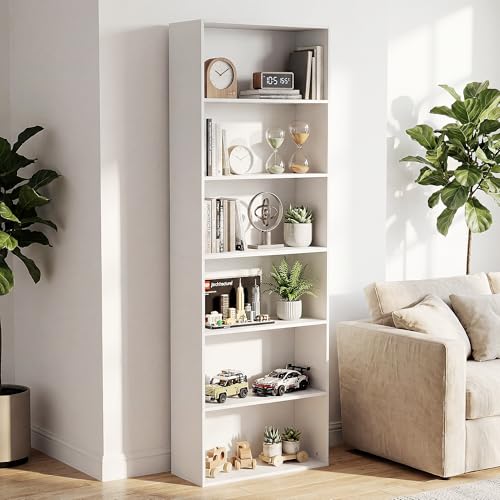
Large Storage Space: With six spacious tiers, each standing 11.2" tall, this white bookshelf provides ample storage for all your essentials. Whether you're organizing books, DVDs, decorative pieces, or toolboxes, everything fits effortlessly. Create an organized home with our stylish book case

Stable & Reinforced Structure: This solid bookshelf is built with tough metal support brackets and high-quality MDF panels to deliver stable long-term performance. Triangular reinforced corner joints plus H-style mortise and tenon joints cut down wobbling significantly, and the included anti-tip wall anchor kit adds an extra layer of safety when you place the unit around your home
Accessibility Considerations

A six-shelf bookcase parked behind a sofa sounds generous until two or three of those shelves sit below the back of the couch and effectively disappear. I learned this the hard way with a set of Facebook Marketplace finds that were bigger than the wall I’d planned for. The narrow row-home layout forced them behind the sofa instead, and for months I treated all six shelves as equal real estate.
The bottom two shelves became a graveyard for things I actually needed: spare remotes, the good coasters, a notebook I reached for during calls. Retrieving any of it meant kneeling on the cushions and fishing blind over the upholstery. Meanwhile the top shelves, the easy ones, held decorative boxes I opened maybe twice a year.
The fix is dead simple once you accept the geometry. The upper shelves, the ones you can see and touch from standing height, are for daily use: the book you’re halfway through, the charger, the candle you light after work. The occluded lower shelves are for long-term storage: backup linens, off-season items, the art you rotate in when you get bored. In a 1060-square-foot space, that buried shelf space still matters, but only if you fill it with things you’re comfortable forgetting about until spring cleaning.
Recommended Products

【Great for Narrow Space】With full dimensions of 78.7" L × 5.9" W × 29.9" H, this narrow sofa table is designed to fill the awkward small gap between your sectional sofa and the wall or window sills. This couch table behind sofa maximizes your sofa side space while creating a more coordinated space.

【Great for Narrow Space】With full dimensions of 102.4" L × 6.3" W × 29.9" H, this narrow sofa table is designed to fill the awkward small gap between your sectional sofa and the wall or window sills. This couch table behind sofa maximizes your sofa side space while creating a more coordinated space.

Designed to Fit Perfectly Behind the Door: This behind the door bookshelf(3.9"D x 23.6"W x 63"H) is specially designed to utilize unused vertical space, making it an ideal storage solution for small rooms, apartments, and tight spaces without blocking door operation.
Space Utilization

Narrow row homes and historic townhomes force you to rethink what a wall is worth. Bryce and Stefan’s 1920s Philadelphia row home runs just over a thousand square feet with a staircase cutting straight through the living and dining rooms. The space is too tight for the usual furniture parade, so the back of the sofa became their only real estate.
A bookcase tucked behind the couch turns vertical space into floor space you do not have. Six shelves of storage sat where nothing but air had been, with the upper rows kept open for daily use and the lower ones given over to things touched once a season. The trade is simple: you lose the grab-and-go convenience of those bottom shelves and gain a footprint no other arrangement could unlock.
This only works when the piece earns its keep. That bookcase was meant for a different wall entirely, bought too large and too loved to return. Forcing it behind the sofa was not the plan; it was the constraint that made the room function.
Recommended Products

Space-Saving Design for Modern Living: With a compact footprint yet generous display cabinet, this tall narrow white bookshelf (a slim bookshelf and skinny bookshelf) maximizes vertical space without overwhelming rooms. Style this narrow bookcase beside a reading nook, beneath a gallery wall, or as a room divider to elevate your interior narrative. Perfect as a tall bookshelf for any room.

[Versatile Storage] Ideal for CD collectors, book lovers, and movie enthusiasts! This media storage cabinet features 33 adjustable shelves, allowing you to customize the space for DVDs, vinyl records, games, or even decorative figurines. No more struggling with fixed DVD racks that don’t fit your growing collection. The tall design maximizes vertical space—perfect for small apartments or cluttered rooms.

LARGE STORAGE CAPACITY: Measuring 40.1" W x 8.6" D x 64.5" H, this 8-tier media tower features 24 spacious compartments. Each shelf offers a standard 12.7" W x 6.4" D x 7.5" H of inner space, featuring shelves that are adjustable up and down by 1.25 inches. This flexibility provides the perfect customized dimensions for organizing massive collections of CDs, Blu-rays, and video games.
Design Challenges

Small, dark living rooms with irregular proportions force you to ignore every standard layout rule you have ever read. The advice about traffic flow and focal points assumes a rectangle with a fireplace on one wall and a doorway on another. The real apartments I have looked at have load-bearing columns in the middle, windows on the north wall only, and an opening to the kitchen that slices through where a sofa should go. The sofa ends up floating in the room because no wall is long enough, and the wall that is long enough holds the radiator.
A bookcase behind the couch is not the textbook answer for any of this. Textbooks would tell you to pull the sofa away from the window, face it toward a media console, and leave thirty inches for a walkway that does not exist. The bookcase placement works because it steals depth from behind the seating, not from the scarce floor space at the sides. It turns the back of the sofa from dead zone into usable territory, which matters when the room is maybe twelve feet across and every inch feeds a circulation path. I have measured apartments where the distance from the entry door to the opposite wall was so tight that a standard coffee table would block the swing. Pushing storage to the rear wall instead of the sides keeps the narrow corridor in front of the sofa clear.
The tradeoff is that the bookcase becomes the new focal point by default, and it faces away from whatever light the room gets. That darkness is the problem you started with, so you plan for it: open-backed units let wall color show through, and keeping the top shelf lower than the door casing stops the piece from reading as a solid mass. Conventional advice calls this backwards. In this room, backwards is the only direction that works.
Recommended Products

【Spacious 6-Cube Storage & 45” Long Tabletop】 This 6 cube organizer features 6 open cubbies and a 45-inch expanded tabletop, offering versatile storage for books, vinyl records, toys, clothes, and home decor. Each cube fits standard 11-inch storage bins, helping you organize every corner of your home with ease.Overall size : 45(W) x 13.8(D) x 31.5 (H) inches.Each cube size: 14.8 (W) x 13 (D) x 11.8 (H) inches.

3 tier Entryway Console Table: The industrial sofa table is made of sturdy metal frame and chunky wood-grain MDF panels, perfect for displaying lots of things like books, decorative plants and framed photos; it will add a warm atmosphere to your entrance, and you can place the rustic console table with storage for living room as a display table.

MODERN & FUNCTIONAL DESIGN: This 3-tier book shelf showcases a compact rectangular frame with a closed back, making it a modern fit for living rooms, bedrooms, or small home offices while maximizing vertical storage
Material Considerations

Open shelving keeps the room from feeling boxed in, which matters when you are already layering a sofa and a bookcase in the same sight line. I skip cabinets with doors for this spot unless the couch sits in an open-plan space where the back faces a kitchen or hallway and the clutter needs hiding. The open back of a standard bookcase also lets wall color show through, so the mass does not read as a monolith.
Depth is the hard limit. A standard 12-inch bookcase depth works behind most sofas because it stays below the back height of a typical seat. Go deeper and you lose the low profile that makes this layout read as intentional rather than desperate. Bryce and Stefan’s Facebook Marketplace find started out too big for its original purpose; behind the sofa, the depth was the saving grace that kept it from swallowing the narrow row house room.
Accessibility splits by shelf height. What sits above the cushion line stays grabable daily. Below the sofa back, I treat it as deep storage: off-season items, the box of cables I open once a year.
Recommended Products

Sleek Charging Station Built-In: This narrow console table with 2 AC outlets and 2 USB ports built in. Perfect as a sofa table with charging station or behind couch table with USB ports — plug in lamps, phones, laptops. 4.9ft cord for flexible placement. Ideal living room furniture with power outlets.

Multifunctional and Stylish: Whether you choose to use this in your living room as a console table, spare bedroom as a foyer table, study room as a bookshelf or dining room as a buffet, this farmhouse sofa table will make a stylish and practical addition to your home.
Sleek Charging Station Built-In: This narrow console table with 2 AC outlets and 2 USB ports built in. Perfect as a sofa table with charging station or behind couch table with USB ports — plug in lamps, phones, laptops. 4.9ft cord for flexible placement. Ideal living room furniture with power outlets.
Frequently Asked Questions
Recommended Products


Back to School Theme: teacher desk skirt features a colorful pencil cartoon print with pink eraser for a lively school season look; Helps create an upbeat learning setting on Teacher display surfaces and activity setups during the return
What are some creative ways to use a bookcase behind a couch?
A bookcase behind a couch works as a decorative focal point, storage solution, and space-saving layout all at once. The top third of a six-shelf unit rises above typical sofa backs and carries framed art, small lamps, or ceramic pieces without a single nail in the wall. Lower shelves hold board games, off-season blankets, or extra cables you access quarterly, not daily. In narrow rooms, this placement also gives the sofa a visual back instead of blank wall space.
How can I maximize space in a small living room?
Tuck a bookcase behind the sofa to turn vertical space into storage you otherwise could not fit. The piece earns six shelves in a footprint already spoken for, with daily-use items kept on upper shelves and long-term storage below where the couch back blocks access. This keeps the narrow corridor in front of the sofa clear and stops standard furniture spacing from eating the whole floor. Open-backed units help wall color show through so the mass does not read as a solid block.