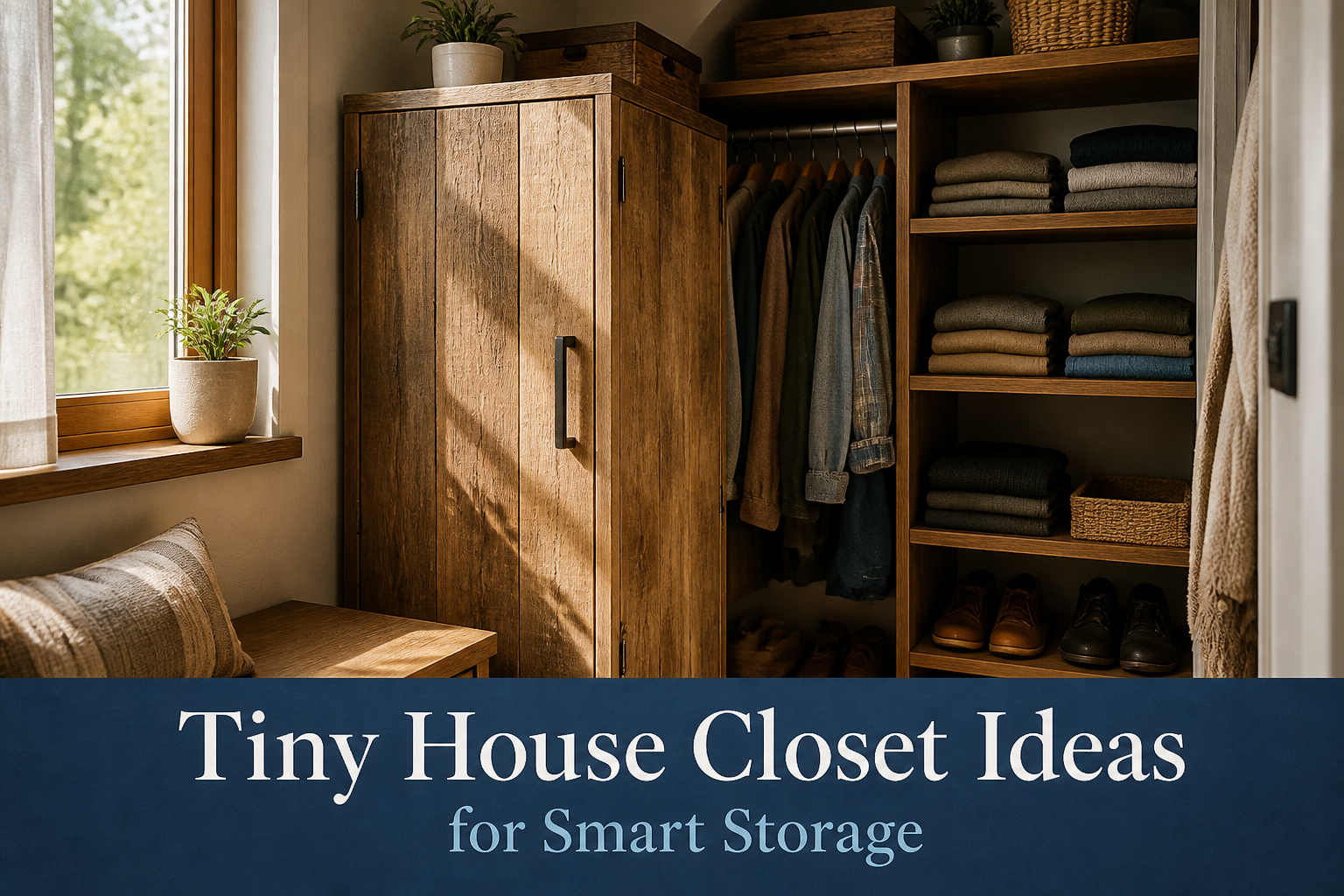
The right tiny house closet idea depends on how often you actually touch your clothes, not how many you own. Hooks stop the chairdrobe only if you cap them at four per person; under-bed drawers work only for items you reach for less than once a month. A 41-inch-high, 24-inch-wide cabinet hides what open shelves cannot, and that pairing is what keeps a 200-square-foot wall from looking like a storage unit.
1. Hooks for Frequently Used Items

The chairdrobe — that pile of clothes technically clean enough to wear again but too worn to fold back into a drawer — eats floor space in tiny houses faster than anything. Three sources all landed on the same fix: hooks for clothes, mounted where the garment stops between wearings, not in a closet you have to open.
I mount mine just inside the front door and one set behind the bedroom door. A fleece jacket, yesterday’s jeans, a cardigan over a camisole — each hangs in the open air instead of souring in a heap, and the visual reminder means re-wear actually happens before the item migrates to laundry. For anything worn once and not yet dirty, this beats the closet because out of sight really does mean out of mind in 200 square feet.
Metal over-the-door racks work for renters; screwed-in wall hooks hold more weight for owners planning to stay. Either way, keep the hook count low. Four spots per person forces the decision: wear it again today, or it goes to the wash. Unlimited hooks and the chairdrobe just climbs the wall.
Recommended Products
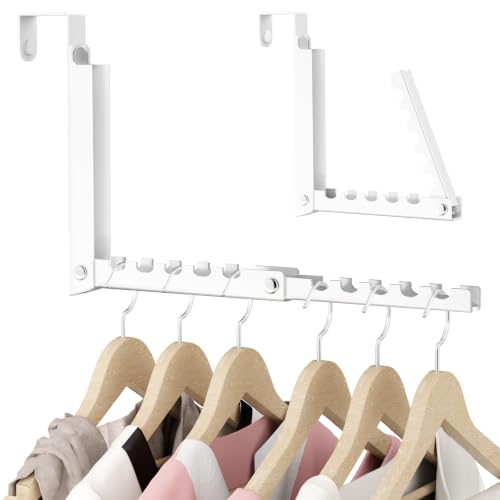
SPACE-SAVING FOLDING DESIGN: This BAKON over the door hanger features an exclusive folding design with 10 slots, allowing you to hang multiple items such as clothes, bags, towels, and hats at the same time. Designed specifically for small spaces, it maximizes the use of the area behind the door, offering better space utilization than other over the door clothes hangers. When not in use, it folds flat to save space
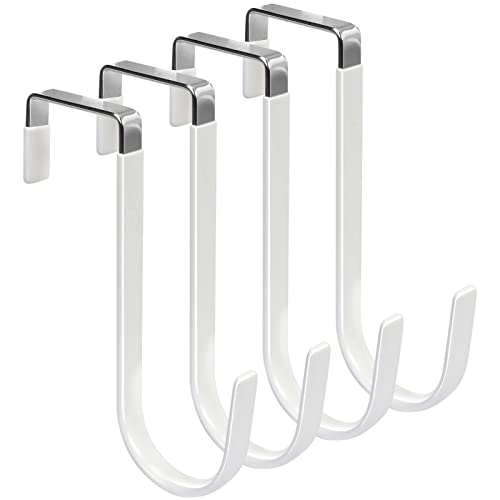
High Quality: Our over the door hooks are made of heavy duty metal, which is durable and rust-resistant, will not deform and ensure a long-lasting performance. Each hook can hold up to 20lb

【Extra 2 Hooks & Storage Rack】Over the door hook rack with 2 hooks, the hooks suitable for towels, coats, hats, backpack, wallets, jackets, umbrellas, etc. The sturdy hanging rod can be used for hanging daily clothes, and the storage rack on top can store other small items.
2. Under-Bed Storage Solutions

I gave up on keeping off-season clothes in my tiny closet the day I measured the hanging depth of a folded stack against the footprint of a drawer. The closet in my last place had barely eighteen inches of clear floor once the door swung in. Under-bed drawers that run 24 inches deep reclaimed almost four linear feet of storage without touching wall space.
Not everything earns that real estate. Daily-use items belong in the closet proper, where your eyes find them. I move anything I touch less than once a month to the bed zone: spare linens, winter layers once April hits, the one blazer I keep for weddings. Sources consistently separate frequent from rare access this way, and the sorting matters more than the container.
The container still matters some. Clear bags let you spot a sweater without unfolding the stack, which I like in theory. In practice, I fold badly enough that a fabric bin with a top flap wins out; you open it, grab, close it. Wheeled boxes exist if your floor gap is tall enough to roll them clear. My frame sat too low for that, so I slid bins on a scrap of plywood to save the hardwood from scratches.
What stays out of under-bed entirely: anything damp or perishable, anything you need in a hurry. Shoes at 9 by 12 inches per pair technically fit, but digging for them flat on the floor ruins a morning.
Recommended Products
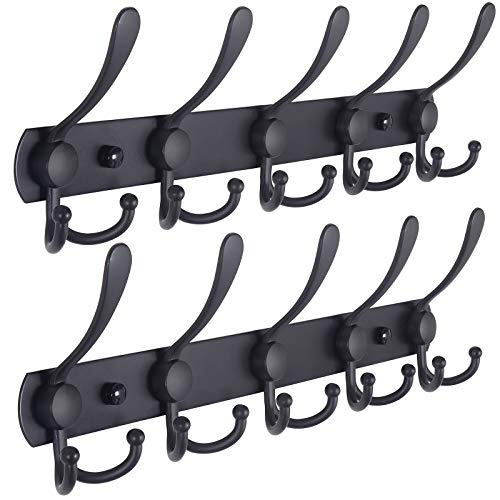
1. Heavy-duty and durable with a simple yet stylish look

Heavy Duty Hooks- Hold up to 30 pounds without bending or breaking. These wall-mounted coat hooks are good for heavy winter coats, backpacks, and more. Made from premium metal for long-lasting durability.

【Overall Size】: 14.5''L * 1.2''W * 3''H.For more details of the measurements you can refer to the size chart in the picture.
3. Open Shelving for Visibility

Open shelving works when you accept that everything on display earns its place. A folded shirt at standard dimensions, 10 inches wide by 12 inches deep, takes the same footprint whether it sits behind a door or faces the room; the difference is you see it every morning, so the pile has to stay neat. I use a few open shelves in my own setup for exactly that reason: they force editing.
The tradeoff is immediate. Storage density drops because you cannot pack items tight without looking messy, which means some square footage gets sacrificed to appearance. Twelve-inch shelves handle casual folded wear well, but anything bulkier needs a deeper platform or a different system entirely. Where open shelving earns back its keep is speed. The signal from every ranked source lines up here: open storage is functionally a display rack, not a hide-it-all cabinet.
Layered lighting helps make the judgment call easier. Shadows turn navy into black and make a tidy shelf look jumbled; overhead light on dimmer, plus whatever task light you can position, turns the same shelf into something closer to a retail fixture. I would skip open shelving entirely for the stuff you do not want to curate, the socks and the off-season layers. Those live better in drawers or behind doors. What stays out are the pieces you reach for daily, folded to that 10-by-12 footprint so the row stays even and the eye reads the shelf as intentional rather than chaotic.
Recommended Products

80L Expandable Larger Capacity : Under the bed storage with dimensions 31.5 x 15.75 x 9.45 inches (with wheels), height adjustable from 9.45" to 11.02" to fit most bed frames. Perfect for storing clothing, shoe, bedding, pillow, towel, and seasonal decor like wrapping paper, Christmas and Halloween supplies. Slides smoothly under bed, couch, closet and table to maximize unused space

LARGE UNDER BED STORAGE:Fokyfok under the bed storage offers 3 times the capacity of a regular under the bed storage containers,allowing you to make good use of the lower space,our under the bed storage with wheels can be used as under crib storage,under couch storage,college dorm under bed storage drawers,shoe rack under the bed, With its generous size, you can store and organize a wide range of items, from clothing and bedding to shoes and seasonal decorations

DIMENSIONS: 29.13"L x 17.38"W x 5.88"H. Inside: 27"L x 14.5"W x 4"H.
4. Cabinets for Hidden Storage

The open shelves in my own tiny house closet sit flanked by two cabinets, and that pairing is what keeps the whole wall from feeling like a storage unit. Each cabinet measures 41 inches high, 24 inches wide, and 24 inches deep, a footprint that leaves room for a decent rod inside while staying shallow enough that nothing gets lost in the back.
Doors earn their keep by hiding what open shelves cannot. Seasonal clothes, the spare set of sheets, and that inevitable landing-pad clutter of keys, mail, and whatever came home in your pockets all disappear behind a flat panel. The visual rhythm stays steady. A jacket sleeve or a bin that sits slightly askew reads as noise in a 200-square-foot room; in a cabinet, it simply does not register.
I tend toward the same finished pine the sources describe, with trim along the edges to give the bank of storage one clean line across. Shelves above the rod can go in later if you find the headroom is wasted, but start with the rod and one shelf. You can always add; subtracting means patching holes and matching stain three years down the road.
Recommended Products

Front Opening Design: Storage bin has a unique front opening that allows you to easily access items even when it’s placed on high closet shelves, without the hassle of rearranging boxes. Homsorout storage bins brings more thoughtful storage design

Clear Window: All storage cubes feature a front window, making it easier to see and find items inside. Our storage boxes with lids save time and effort, making storage more convenient and efficient

【4PACK LINEN CLOSET STORAGE with SEE-THROUGH WINDOW】Each linen closet organizers and storage box features a clear window, allowing you to see the contents at a glance, making it super convenient to find what you need in no time.
5. Multi-Purpose Furniture

Multi-purpose furniture earns its floor space by doing two jobs at once, which matters when a tiny house leaves you a closet the width of a doorway. A storage bench at the foot of the bed holds off-season sweaters inside and gives you somewhere to sit while you lace up shoes. I looked through dozens of tiny house tours while planning my own layout, and the ones that stayed livable all had this trick in common: the bed itself carried drawers underneath, or the ottoman opened up to swallow linens.
Sources mention this approach constantly but rarely name specific pieces, so I had to hunt for what actually exists. A hollow ottoman with a lift-top lid stores about as much as a small dresser drawer. Beds with built-in drawers underneath eliminate the dust-collecting gap where the floor shows through. The catch is weight: a storage bench loaded with wool blankets gets heavy fast, so check that the hinges feel solid before you buy. For renters, a standalone storage ottoman moves with you; built-in bed drawers stay with the house.
Recommended Products

Versatile Storage Solution: This storage cabinet features two doors and is available in black and white colors. It provides ample space to organize various items, from office supplies to non-perishable food and extra miscellaneous belongings

Built to Last: The frame of this pantry cabinet is constructed from FSC-Certified wood. It includes wall-mounting for stability, ensuring it can handle daily use while keeping your kitchen tidy for years to come.

【Stylish Farmhouse Design】Featuring streamlined beadboard doors, white wood finish with black knobs, designed to blend into a variety of decor styles and color schemes. Embrace the warmth and charm of farmhouse style with Function Home pantry cabinet.
6. Vertical Storage Solutions

Wall-mounted rails that reach toward the ceiling turn the upper foot of a tiny house closet from dead zone into active storage. I found, reading through a dozen builds, that the most efficient ones treat the ceiling line as the finish line for everyday items, not the starting gun for dust. Seasonal coats or the dress shirt you wear twice a month can sit on hangers at that height; a slim wooden step stashed nearby keeps it reachable without the bulk of a permanent ladder. The minimum hanger depth you need is 20 inches for standard adult shoulders, so anything shallower forces you to angle garments and lose width.
Ceiling-reaching cubbies with baskets solve what happens above hanging height. One builder I tracked sized his cubby grid for plastic totes that slide in like drawers; another lined open boxes with fabric to match her loft cushions. Both kept the look clean from below while storing off-season bedding where stairs or a grab stick could reach it.
Furniture that doubles as storage works harder still in a loft closet. A hollow bench at the closet threshold holds the step you’re already using; the top lifts for spare sheets or the vacuum attachments that would otherwise rattle against walls. The trade-off is floor footprint against wall access. In a closet under 32 inches deep, the bench usually loses. Mount first, supplement with built-ins only after you’ve lived in the space long enough to know what stays and what migrates to the main loft.
Recommended Products
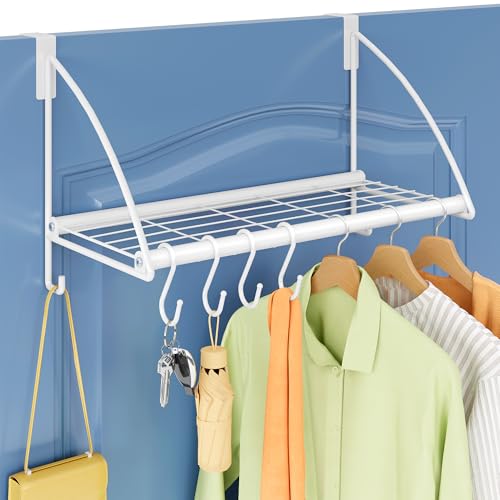
【Over the Door Hanger】Unlike other over door hangers, our over the door clothes hanger adds new organizing options. The sturdy hanging rod can be used for hanging daily clothes, and the storage rack on top can store other small items.

Extended Arms: Door towel rack comes with 7.1 inches extended arms, you can hang your clothes easily without standing on tiptoe. Make sure there is a coin gap in the door for closing before ordering
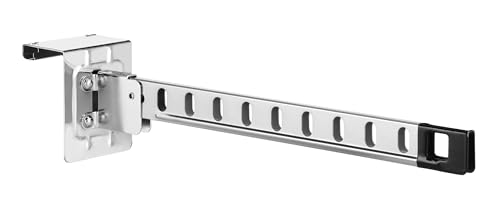
SPACE-SAVING FOLDABLE DESIGN: This over-the-door hanger holder folds flat against the door when not in use, keeping your space neat and clutter-free. Perfect for apartments, laundry rooms, bedrooms, closets, dorms, and small living spaces.
7. Drawer Organizers

The first thing I noticed after installing drawer dividers in my own closet was how fast the "junk drawer" problem spread to clothing storage. A 24-inch-deep drawer sounds generous until you dump in socks, workout gear, and three seasons of bathing suits loose on top of each other. That depth eats small items alive.
What works is treating the drawer itself as a shelf that happens to slide. File folding soft fabrics into the exact height of the organizer, then standing them in rows front-to-back, lets you see every item at once. For firmer pieces like jeans, vertical stacks hold their shape without the extra step. The divider creates rows where there was only a pile, which matters more than the exact brand or material of the box you buy.
Dividers also corral the accessories that migrate into clothing storage. Setting up a top drawer with lined trays and compartmentalized inserts keeps jewelry and sunglasses from shifting into a tangled corner, and the same logic applies to hair tools or small bins for trinkets. Color coordination helps, though I have found that protecting the item comes first, matching second.
Manufacturers rarely publish drawer dimensions for these setups, so your planning starts with what you own, not what a label promises. Buy organizers after you know the fold height of your sweaters, not before.
Recommended Products

Premium Material: Our wall hooks are 100% made of zinc alloy and the screws are made of iron, which is hard and durable, not easy to break, anti-rust and anti-corrosion. And it can easily hold up to 40 lbs of weight

【Metal Wall Hooks Strong & Sturdy】Keep everything organized & within reach! The heavy duty double prong metal hooks are made of good quality zinc die cast material, the screws are made of iron, it can easily hold up to 40 lbs of weight, very strong sturdy and beautiful, hooks easy storage and long-term use, meet your storage needs.

Premium Material: Our wall hooks are 100% made of zinc alloy and the screws are made of iron, which is hard and durable, not easy to break, anti-rust and anti-corrosion. And it can easily hold up to 40 lbs of weight
8. Storage Bins and Baskets

Storage bins and baskets earn their keep in a tiny closet because they turn vertical gaps into usable territory. A 9-inch high, 17-inch wide, 18-inch deep shelf, the kind common in built-in tiny house closets, fits standard bins almost exactly. Uniform sizing matters more than the label on the front: one style and color, stacked to the same height, keeps the eye reading a single plane instead of visual noise.
Labelling decides whether the system lasts past the first week. Canvas bags that fold flat when empty, like the Coverstore set, work for seasonal rotation because they compress to nothing once you unpack. For daily access, hanging baskets or under-shelf containers keep the floor clear and the contents visible. A round basket on the floor handles flip-flops and sneakers you grab without thinking.
Materials separate the bins that survive from the ones that sag. Woven storage with cotton lining, such as the Montauk bins, keeps snags off delicates. Metal baskets stack rigidly for folded jeans and heavier items. Humidity swings in a tiny house, especially between a compact bathroom and a front closet, will warp cheap fabric and rust inferior wire; the sturdier build pays for itself in shape retention.
The visual calm of matched bins falls apart if your hangers clash above them. Wooden hangers in one cut, kept consistent across the rod, do the same unifying work the baskets do below. The hanger is not storage, but it frames what the storage built.
Recommended Products

Under Bed Storage with Wheels: Engineered with metal frame, industrial style wood panels, beautiful appearance, offering 3X the durability of fabric organizers. Built to hold heavy blankets, books, or seasonal wardrobes without sagging

1.Wheels, yes, this is the point you should pay attention to. We use 1.5-inch metal wheels, which are durable and easy to slide even on carpets. The other underbed storage boxes use ordinary black plastic wheels, which are easily damaged after a few months.

Under Bed Drawers On Wheels: Engineered with metal frame, industrial style wood panels, beautiful appearance, offering 3X the durability of fabric organizers. Built to hold heavy blankets, books, or seasonal wardrobes without sagging
9. Clothing Racks for Visibility

Three years in a 1950s cottage cured me of romanticizing open storage. The closet was microscopic; my grandmother was right that people owned almost nothing back then, so the builders saw no need. I switched to a freestanding garment rack for daily wear and kept the closet itself for off-season coats and dust-prone pieces.
A wall-mounted or freestanding clothing rack works best with a disciplined wardrobe and dry air. Emily Henderson’s preference for visible storage rings true if you dress visually, yet that same visibility becomes liability fast. Dust settles on shoulders within forty-eight hours where I live; humidity would add mildew to the equation. The industrial-style open racks now flooding the market, Levy’s included, solve nothing about environment.
What redeemed the experiment for me was a single heavy hook beside the rack. Morning discards, pajamas, the "nothing to wear" tossing pile, all landed there rather than back on hangers or wadded on the floor. The hook saw harder use than the rack itself.
Wall-mounted rails preserve floor space in a tiny house, but every item becomes décor whether you meant it to or not. Good layered lighting helps distinguish navy from black, as Kobel + Co notes, though I found it also exposed every faint stain I had ignored in dim closets. The rack lasted eight months before I reclaimed the closet for everything and moved the hook inside the door.
Recommended Products

【Three Sizes for All Your Need】Our acrylic purse organizer comes in three sizes to meet your needs. The Medium size (14.21"x10.67"x5.27") and the Large size (14.21"x10.67"x8.50") are perfect for purse, pouch and small shoulder bags. While the X-Large size (17.30"x13.70"x11.80") accommodates most bag sizes, including large hand bags, totes, and backpacks. Both sizes provide an elegant and secure solution for storing and displaying your cherished handbags

See-Through Clear Window: Built-in clear window on the front — see contents at a glance without pulling the bin off the shelf. Our fabric storage bins keep sweaters, scarves, and baby blankets visible and easy to grab.

Premium Material : The under bed storage containers are made from high-quality, odorless, three-ply composite non-woven thick fabric, foldable and breathable, keep clothing fresh from long-term storage. NO cardboard NOR metal supports insert, arrive to you collapsed and packaged in a clear storage bag.
10. Custom Closet Systems

Built-ins turn a tiny house loft into actual usable square footage instead of a sloped corner where bags go to die. A custom system can be tailored to how you intend to use the space: bedside tables if you are sleeping up there, open shelving if it is a reading nook, or a full cabinet wall if one loft is dedicated to storage and the other stays open for living. The Skyline Shore Park 1934AD comes pre-installed with exactly this kind of thinking, but plenty of owners add their own after move-in once they know what they actually need within reach.
Finish work eats more hours than rough framing, though. One couple logged 7 hours of work between two people to complete their closet and shelves, and they stressed that mocking up the layout first saved the project. Brainstorming ideas on paper let them tweak shelf height and closet spacing before cutting anything, which kept the construction phase straightforward. The result held more than expected and looked integrated rather than apologetic. If you have not lived in the space yet, holding off on permanent built-ins is not a mistake. You will have a better sense of what organizing systems suit your habits once your first month of daily use has shown you where things actually land.
Recommended Products

【𝗔𝗱𝗷𝘂𝘀𝘁𝗮𝗯𝗹𝗲 𝗟𝗲𝗻𝗴𝘁𝗵 𝗮𝗻𝗱 𝗛𝗲𝗶𝗴𝗵𝘁】: ---The package includes 2 pieces of kitchen counter shelf of size (15.5”-25.5”)L * 8.26"W * 8.72"H. Both can expand length from 15.5" to 25.5" and adjust shelf height from 4.5 to 7.3 to fit your storage needs just about anywhere.

SOLVE YOUR STORAGE CHALLENGES – This storage cabinet provides a sleek solution to your clutter, offering ample space for all your essentials while enhancing your home’s aesthetic

【𝟭𝟮" 𝗪𝗶𝗱𝗲𝗻𝗲𝗱 𝗪𝗼𝗿𝗸𝘁𝗼𝗽】We’ve widened the metal storage shelf to deliver ample storage space for all your essentials. Please confirm the dimensions before purchase to ensure a perfect fit.
Declutter Before You Organize

Take everything out before you measure a single shelf. 82% of the clothes in the average closet go unworn in a given year, and those untouched pieces are what make a tiny house closet feel impossible.
Last spring I helped a friend sort her 28-square-foot wardrobe wall. Three hours in, she found a blazer with tags from 2019 blocking the rod she needed for work shirts she wore twice weekly. The space had not changed; what she kept in it had.
Aim to keep the closet 80% full. That leftover breathing room keeps you from fighting the rod every morning and lets you actually see what you own. Toss a donation bag on a hook or back corner so purging becomes routine, not a quarterly event.
Only after the editing do you pull out the tape measure. Designing storage around a false inventory means shelves for jeans you will not fold and extra height for skirts you never reach for.
Plan From What You Actually Own

A men’s suit coat needs 1-1/24 inches of rod depth and 38 inches of vertical clearance; a women’s dress hangs 68 inches long. Those two numbers decide whether your tiny house closet can hold what you already own or forces a second round of edits. I lay every piece I want to keep on the bed, measure against my own body first, then check the tape. A pair of shoes eats a 9-by-12-inch footprint whether you own two pairs or twelve, and that rectangle adds up faster than hanging space.
Before sketching a layout, I sort into keep, fold, and hang piles. Items worn often live at standing height; out-of-season pieces earn the bend-over drawer or the high shelf. The standard dimensions don’t change for small spaces, but how you meet them does:
| Storage need | Minimum depth | Vertical use | Best placement |
|---|---|---|---|
| Men’s suit coat | 1-1/24 in | 38 in | Primary hanging rod |
| Women’s dress | varies by style | 68 in | Tallest rod allowance |
| Shoes (per pair) | 9 in x 12 in | stacked or flat | Lower shelves or floor-level cubby |
| Folded stack | 12 in deep | 10 in tall per layer | Mid-height shelf |
| Drawer pile | 18–24 in deep | n/a | Below waist level |
The 68-inch dress length convinced me to put the top rod at 72 inches even though I am 5’4" on a tall day. A step stool lives in the closet now; reaching beats hemming clothes I already paid for.
Store Seasonal Gear Out of the Way

Seasonal gear is the easiest stuff to misplace in a tiny house closet because you reach for it so rarely. Anything you wear fewer than five times a month belongs on the highest shelf or in the lowest drawer, since bending or stretching costs less than losing square footage to things you never touch. I used to stack off-season coats at eye level until I realized they were blocking the work shirts I needed every morning. Relocating them freed up the prime zone and kept the closet from feeling like a storage unit. Folding formal pieces into canvas bags that collapse flat after summer also helps if your shelf depth is shallow, which it usually is in a loft closet. The point is to decide the real estate before you build: measure what you actually own, figure out how much of it is occasional, and let that ratio drive where the rods go versus where the high shelves sit. Most tiny home plans get this backward and prioritize hanging space for everything. Mine doesn’t, and six years later I still swap winter and summer without emptying half the room onto the bed.
Use the Loft for Overflow

The loft in a tiny house sits outside the usual floor plan, so most sources skip it when they talk about closets. That gap is worth filling. If your main living area already handles sleep and daily storage, the whole loft can become an overflow annex instead of a spare bedroom or dust-collecting second living room.
Dedicate the entire loft to storage and you trade a few square feet of headroom for the cost and hassle of an off-site unit. The catch is access. A full loft packed floor-to-ceiling turns into a sealed attic where nothing comes back out. Leave pathways wide enough to walk, and build an inventory as you load boxes. A friend of mine watched her mother lose three winter coats to a loft she could not physically search. Labels matter more up there than anywhere else in the house.
Split lofts give you half-measures. Some park models come with a double loft reached from separate stairs. One side sleeps, the other stores. The stored half still needs the same discipline: clear lanes, labeled bins, and a running list of what went up when. Without that, you are just moving clutter vertically.
Frequently Asked Questions
How do I maximize space in my small closet?
Thoughtful organization and intentional design matter more than square footage. Start by removing everything and keeping only what you wear; 82% of clothes in the average closet go unworn in a given year. Build in vertical storage with wall-mounted rails toward the ceiling, and leave the closet 80% full so items stay visible and reachable.
What are some space-saving clothes storage ideas for tiny homes?
Use ceiling-reaching cubbies with slide-out baskets, mount hooks just inside doors for clothes worn between washes, and add under-bed drawers that run 24 inches deep for off-season layers. Multi-purpose furniture like a storage bench at the foot of the bed also reclaims floor space by doing two jobs at once.
How can I keep my clothes organized in a tiny home closet?
Adopt minimalist storage systems and keep only pieces you love to wear often. File-fold soft fabrics into drawer organizers set to their exact height, store daily items at standing height, and move anything touched less than once a month to under-bed bins or high shelves. Uniform bins in one color keep the eye reading a single plane instead of visual noise.
Are there any specific storage solutions for tiny house clothes?
Hanging organizers and ceiling-adjacent storage both work well. Wall-mounted rails need at least 20 inches of hanger depth for standard adult shoulders. For the loft, build cubby grids sized to plastic totes that slide in like drawers, or line open boxes with fabric to match your cushions. A hollow bench at the closet threshold can also hold a step stool and spare linens inside.