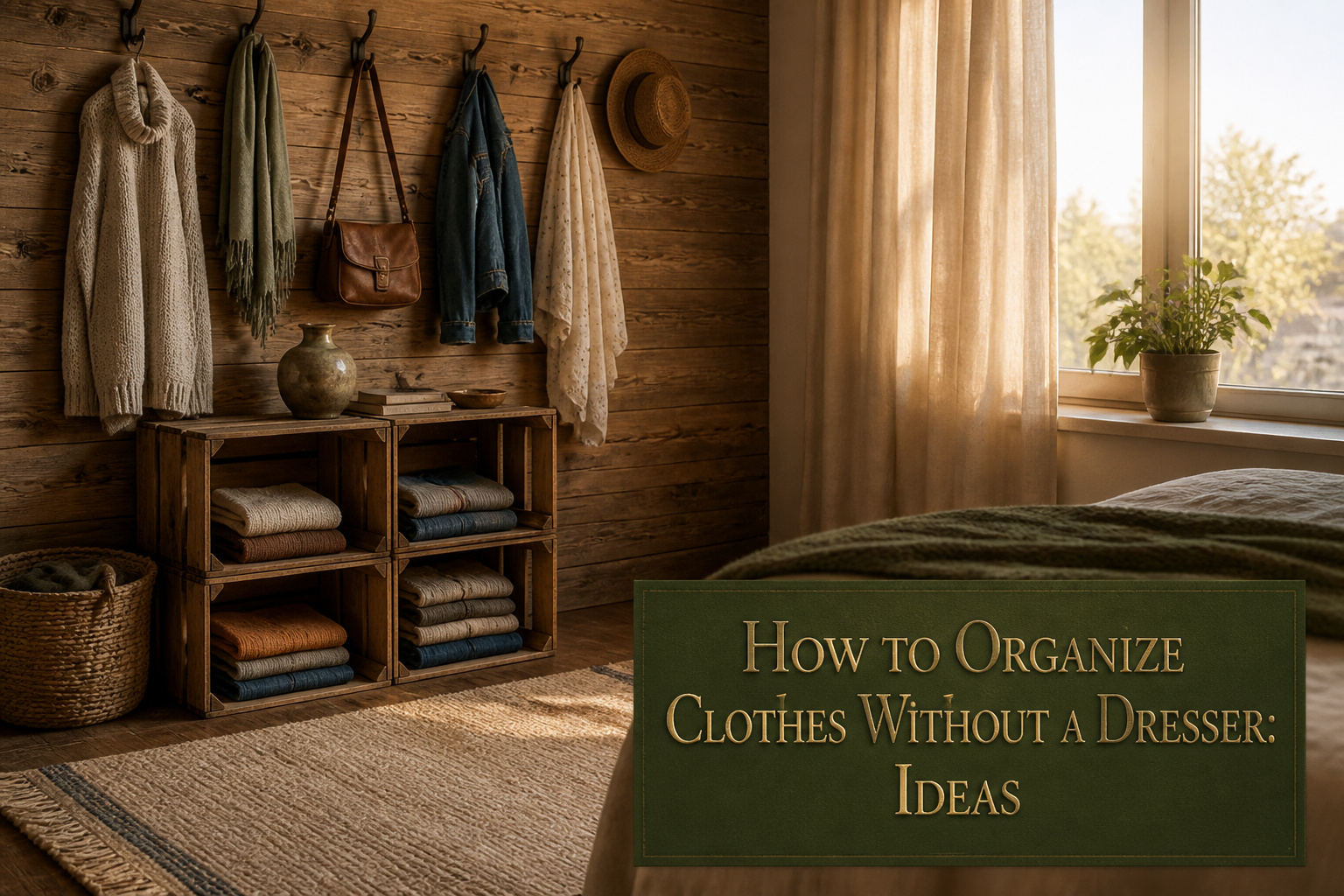
You can replace every drawer a dresser ever held with a freestanding wardrobe, a wall of staggered hooks, or even two wine crates screwed together and stacked in a corner. The catch is that each swap demands a specific discipline: velvet hangers recover 30–40% more rod space than plastic, but only if you commit to the slim profile and accept that heavy wool still needs wood. I learned that the week my silk blouses started sliding into a pile on the closet floor.
1. Freestanding Wardrobes and Armoires

Freestanding wardrobes and armoires do the same job as a built-in closet without the built-in commitment. Most garment racks come on casters, so rolling them to a new wall when the roommate situation changes takes about thirty seconds. That mobility also means you can pull the whole rack toward you while you fold laundry, rather than crouching to a low drawer.
The real space squeeze inside that rack comes down to hanger choice. Velvet hangers run about 0.2 inches thick against 2–3 inches for standard plastic, and on a 36-inch rod that swap recovers roughly 30–40% more usable length without buying any extra hardware. I set one up in a bedroom barely ten feet across, using the Zober Premium Velvet Hangers at 17.5 inches wide with a swivel hook for one-handed grabbing. The grip keeps silk blouses from sliding, though heavy wool coats still need a wider wooden shoulder to hold their shape. I kept two wood hangers for those and called it done.
Recommended Products

This is a heavy duty portable closet rack, perfect for hanging clothes and organizing your wardrobe closet with ease

Compact Design Closet System - Dimensions: 41.4”W x 16.2”D x 78.8”H, total load capacity 450 lbs. The thickened bamboo frame and shelves are stable and will not wobble or collapse. It's a perfect addition to clothing organizers in bedrooms, cloakrooms, laundry rooms, walk-in closets, corners and other rooms.

【Diversified Usage Scenarios】The portable closet rack can be used at anywhere you need, like entry closet, bedroom, cloakroom, balcony, bathroom, hallway and more.
2. Wall-Mounted Hooks and Pegboards

Vertical space is the first thing renters and first-home owners overlook, and the first thing that makes a room feel workable once it is used. Mounting hooks and pegboards at staggered heights lets a coat, a bag, and a pair of pants occupy the same six inches of wall without stacking on a surface. Decorative hooks work, and so do repurposed door knobs or drawer pulls if the plate behind them spans a stud.
The mistake I keep seeing is treating wall mounting as an afterthought. A pegboard left flat against plaster without anchors pulls loose in months. What convinced me, reading through the guides that actually hold up, is spacing: hooks set too close tangle sleeves and hoods, and hooks set too far apart waste the rail they are bolted to. Three to four inches between centers for accessories, six to eight for outerwear, and a lower row for scarves or belts kept off the floor. When everything hangs at one level, the visual weight drops to that single line and the wall above turns dead space again. Two rows, staggered, turns eight feet of drywall into deliberate storage.
Recommended Products

INCLUDES: 30 suit clothes hangers in Ivory/Silver for keeping shirts, blazers, slacks, and more neatly hung and organized

INCLUDES: 50 suit clothes hangers in Black/Silver for keeping shirts, blazers, slacks, and more neatly hung and organized

INCLUDES: 30 suit clothes hangers in Black/Silver for keeping shirts, blazers, slacks, and more neatly hung and organized
3. Open Shelving Units

Open shelving turned out to be the first thing I tried when I ditched my dresser, and the mistake I made was biting on a pair of flimsy particleboard towers that wobbled by month three. Shelf depth matters more than the product photos suggest. Anything shallower than twelve inches leaves your folded stacks poking out or falling forward; much deeper and you end up layering clothes in rows that hide the back half from view entirely. I learned that spacing between shelves needs to sit at fourteen inches for sweaters to stand upright without crushing the loft of the fabric, though t-shirts squeeze fine at twelve.
A basic bookcase or étagère works here with zero installation, which matters in a rental. I have stacked two shorter units vertically to steal ceiling height I was not using, and the stability surprised me once I bolted the top unit to the bottom with brackets through the side panels. What falls apart over time is the folding discipline, not the shelves themselves. File folding holds for about a week; after that, the front items get pulled and the rest slump into a sideways pile. Acrylic shelf dividers clipping to the shelf edge solve this by creating columns that keep each stack upright even when the middle one is pulled. The clear ones disappear visually; you see the clothes, not the hardware. Four dividers on a standard thirty-six-inch shelf gives you three stable stacks, which I found is enough to sort by weight: heavy knits left, mid-weight sweatshirts center, lighter cardigans right. Rules beat constant re-sorting.
Recommended Products

Expandable Peg Board System: This peg board wall kit is great for wall organizing, craft room storage, ornaments display, and gaming set up. Our pegboard kit can be used as a office organizer, gaming pegboard, bathroom storage, etc

Value Package: Our pegboard tool organizer comes with 120pcs pegboard accessories,16 different type pegboard hooks including 5pcs pegboard bins, curved hooks, angled hooks, straight hooks, and ring tool holder, multi tool rack. 49pcs of them are peg locks for fixing hooks

【𝐔𝐍𝐈𝐐𝐔𝐄 𝐃𝐄𝐒𝐈𝐆𝐍 𝐒𝐓𝐘𝐋𝐄: 𝐓𝐔𝐑𝐍 𝐘𝐎𝐔𝐑 𝐉𝐄𝐖𝐄𝐋𝐑𝐘 𝐈𝐍𝐓𝐎 𝐖𝐀𝐋𝐋 𝐀𝐑𝐓】Drawing inspiration from the rhythmic beauty of wind chimes, this wall-mounted earring holder transforms your messy jewelry collection into a stunning decorative centerpiece. It’s more than just an organizer; it’s a statement piece that adds a warm, vintage vibe to your bedroom vanity, bathroom, or walk-in closet. Say goodbye to cluttered countertops and bulky jewelry box—reclaim your surface space while showcasing your style with this artistic hanging pink jewelry organizer.
4. Under-Bed Storage

Clear bins handle the under-bed job better than anything with a lid you have to peel back in a dim room. I learned the hard way that height matters more than length down there. Most standard bed frames leave about seven to eleven inches of vertical space once the frame rails and any central support legs are accounted for, and a bin that bulges even half an inch above that threshold gets jammed on retrieval or cracks at the lip from being forced.
A flat profile with a low lid hinge works. One solid-sided container I tried, shaped more like a tote, wedged itself against the center support beam and split along the corner seam the third time I dragged it out. The ones that survived were the shallow, truly rectangular bins without decorative stacking rims that steal headroom.
Visibility changes how you use the space. Wheeled drawers roll out well for gym clothes or shoes you grab a few times a week. For the sweater you packed away in May, a zippered bag with a clear vinyl window saves unzipping three fabric sacks to find it come October. Vacuum-sealed bags flatten puffy coats but need a pump close by, and they hide contents so completely that I once stored the same winter layer twice.
If your frame sits too low, risers are the fix that costs least and changes most. Measure your gap before buying bins, and favor the lower wall.
Recommended Products

Dimensions: The dimensions of our product are 16.5 x 2 inches, the length of the hook is 3.2 inches, and the distance between the 2 hooks is 3.2 inches. Suitable for narrow spaces with increased storage needs

【2025 New Coat Rack, Comprehensive Quality Upgrade】① The hook is lengthened, widened, and thickened for better load bearing. ② 1inch optimized hook spacing prevents crowding — fits 4 winter coats side-by-side! ③ Space-saving design, 1" depth hugs narrow doors/the side walls. ④High load-bearing: each hook can bear 25lb ⑤ Product Size: Length: 16.5", Height: 6.7", Width: 1'' .

For A Neat & Tidy Home: Make your home feel super clean & organized! With KIBAGAs’ ultimate set of 5 decorative coat hooks for wall mount you can smartly utilize your available space in style, practically and neatly organized
5. Over-the-Door Storage

The gap between a closet door and its frame is free real estate most renters never claim. An over-the-door shoe organizer with clear pockets hung on the inside of that door turns dead space into a full small-items station. The SimpleHouseware 24-pocket version runs about $8.99 and fits standard hollow-core and solid-core doors, but measure first: if a closet shelf overhangs the door frame by more than two inches, the organizer hits it every time you close the door.
Shoe pockets handle rolled socks, underwear, scarves, and belts without demanding a dresser drawer. The fabric organizers with multiple compartments work the same way, adding cubby space where there was none. What separates the systems that last from the ones that collapse into chaos is pocket assignment. Unassigned pockets become junk drawers in a week. Three minutes of masking tape labels at the top of each row, black socks here, white socks two pockets down, fixes that.
Canvas pocket systems hold folded items and accessories fine, but weight limits are honest enough on cheaper units that stuffing a hoodie in will tear the stitching. Keep the load to what fits without bulging. For renters, the whole setup moves with you, no holes in the wall, no landlord conversation.
Recommended Products
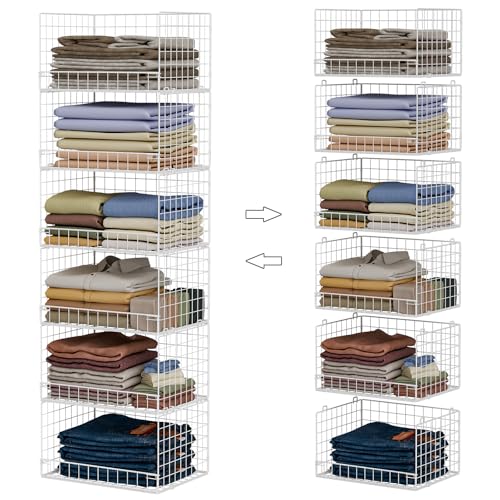
Upgraded Wide Mouth Design】15.7"x11.8"x8.7"(L x D x H) in single size,these clothing organizers are suitable for most size of clothing especially big clothes, pants and jeans.Due to the appropriate depth, the basket will not protrude when placed in the wardrobe. Note: Ensure the product size fits your Closet.

Versatile Storage Solution: The Wardrobe Closet is equipped with four compartments for folding clothes, handbags and storage boxes. The two-tier shoe rack holds fourteen pairs of shoes. The hanging rod area is designed specifically for hanging wrinkle-prone garments such as blouses, jackets, and long dresses. wardrobe is made of high-quality steel, and the top of the wardrobe can accommodate suitcases and large storage boxes. We also provide three additional hooks for hanging bags and belts.

[Pull out storage bins] Featuring a pull out design, these storage bins with drawers allow for smooth and effortless access to your belongings without disrupting the stack. Warm tip: When pulling out a drawer from a stack, hold the top edge of the frame with one hand and gently pull the handle with the other
6. Suitcases or Trunks

Vintage suitcases and trunks live a second life as storage, and the ones that work hardest have one thing in common: hard sides with a real latch, not the zippered fabric shells that collapse under a stack. I sifted through a dozen estate-sale pieces before I noticed the pattern. The 1960s Samsonite carried weight without bowing; the soft-sided roller from 2019 started sagging after two sweaters.
Moisture is the quiet killer here. Wood trunks breathe a little, which helps if you air them quarterly. Sealed plastic suitcases do not. Line anything airtight with an old sheet, not plastic bags; cotton buys you a buffer against humidity trapped inside. Skip the sheet, and that musty suitcase smell transfers straight to your clothes.
I access my trunk-stored clothes twice a year: swap-in day for off-season items, swap-out day when the weather turns. Anything I need monthly lives somewhere else. The bottom suitcase in a stack of three holds last summer’s linen; the top holds what I might actually grab before June. Label the outside with a strip of masking tape and a Sharpie, or spend October mornings unlatching every lid.
Recommended Products

[Easy-to-use Clothes Hanger] This hanger is designed with a high pole of 72 inches in height, which can flexibly hang, trousers, and other items. It is equipped with a side hook for hanging bags, hats, belts, towels, umbrellas

▶【Easy to Install】This Ulif F3 clothes rack measures 40 ''W x 15 ''D x 72 ''H and weighs 28.6 lbs,The fabric drawer size is 24 ''W x 15 ''D x 7.5 ''H,Installation is very easy no extra tools are required,BEFORE installation we recommend that you make sure to watch the installation video and instructions that we have prepared for you!

【Short height fits limited space, access easily】 3.37 feet fit inside your closet to double closet space and you can use closet rod also, fits small loft, child's room, attic, under a stairway to save more space; with this baby clothes rack, you won't annoyed by lift heavy jackets, kids or elderly can easy reach their clothing too
7. Create a Capsule Wardrobe

A capsule wardrobe pares your clothes down to about 30 to 40 pieces, including tops, bottoms, dresses, outerwear, and shoes. That number sounds arbitrary until you actually do the math on your own closet. I pulled everything out onto my bed last spring and sorted into three piles: keep, donate, and a stubborn third pile of stuff I never wore but claimed I might. The 80/20 rule held up embarrassingly well; roughly a fifth of my clothes carried almost all the wear.
The criteria that actually worked for me were boringly practical. Does this survive a normal wash cycle without special handling? Does it work with at least two other pieces I already own? The aspirational items failed both tests and left the pile. Reducing to a capsule does not require becoming a minimalist; it means owning fewer single-purpose garments that eat up storage volume.
With fewer than forty items, a single clothing rack and two wall hooks replaced my dresser entirely. Laundry got faster simply because there was less of it. The hesitation comes in deciding what belongs; no one source lays out the exact same steps, so what you drop depends on what you actually reach for before noon on a Saturday.
Recommended Products

INCLUDES: 30 clothes hangers in Gray for keeping baby and kids' clothes neatly hung and organized

Durable and Sturdy: Crafted from velvet and ABS Plastic; Steadily hold heavy clothing of up to 11lbs; As strong as wooden suit hanger but much thinner and lighter; Durable hanging bar with black velvet to hold your shirt, jeans and pants (Recommended for shirts, blouses, dresses, T-shirts, pants, and lightweight jackets. Not intended for heavy coats, bulky winter jackets, or oversized garments)

INCLUDES: 50 suit clothes hangers in Ivory/Silver for keeping shirts, blazers, slacks, and more neatly hung and organized
8. Storage Furniture and Shelving

An ottoman with a hollow center looks tidy at first, but the lid collects everything you meant to fold. Three years in, mine held exactly two blankets and a growing pile of clean laundry I never got around to putting away. The hinge was the part that failed, not the frame; after about eighteen months of daily lifting, it sagged half an inch so the lid never sat flush again. Benches with lift-top compartments work better for shoes than for clothes, since boots and sneakers keep their shape when tossed in a pile but a sweater does not.
Modular shelving on wheels convinced me during a summer sublet. The 36-inch cube system I used let me roll the whole unit into a closet for guests, then back out for daily access. What broke the deal was the wobble. Once loaded past about fifty pounds per shelf, the connectors started working loose every six weeks or so. For a renter who moves every couple years, the flexibility pays off. For someone settling in, wall-anchored shelves or a secondhand bookshelf with a solid back panel lasts longer and costs less per year.
Recommended Products

MODULAR——By tiling multiple pegboard panels, you can easily match and grow your tool storage system as needed. Special size design make this set adjustable to apply most people's space need.

【Transform Your Gaming Setup from Cluttered to Organized】The KDD RGB gaming desk organizer helps keep controllers, headsets, cables, phones, keys, and gaming accessories neatly organized in one place. Maximize vertical storage, free up valuable desk space, and create a cleaner, more professional gaming station for gaming, streaming, studying, or working

🏡 Easy Wall Mounting – Perfect for garages, sheds, workshops, basements, or craft rooms—instantly turns walls into organized storage space.
9. Curtain Call

A tension rod wedged between two wall studs turns a shallow alcove into a closet you can close. The rod holds the weight, but the curtain does the real work of making exposed storage feel finished instead of temporary.
I tried lightweight cotton first, and it billowed into the room like a sail every time the ceiling fan spun. Heavy drapery fabric, at least 8 oz per yard, hangs straight and stays where you put it. Lining helps, but the weave matters more than the lining; a dense twill or canvas needs nothing behind it to fall flat.
Ceiling-mounted tracks give a cleaner line than a tension rod, though installation takes more than a weekend if you are filling old anchor holes. Track gliders let the curtain stack flat to one side when you open it, which a tension rod never manages. That stack eats 10–12 inches of wall, so plan the rod depth into your layout or the drape will crowd your hanging clothes.
The real payoff is psychological. Open clothing racks read as clutter even when they are tidy. A curtain turns the same rack into a wall. In a rental, you leave two small screw holes at the ceiling track, patch them in thirty minutes, and take the hardware with you.
Recommended Products
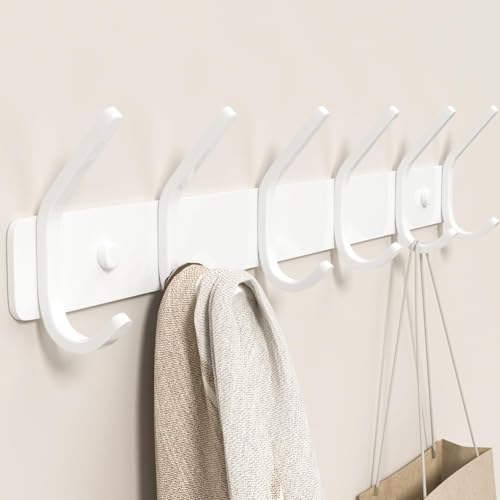
High-Quality Materials: Our coat hanger is made from premium aluminum alloy with a rustproof and waterproof sleek white finish ensuring durability in any environment
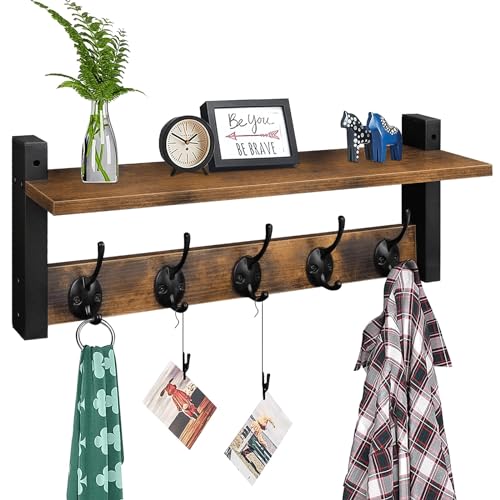
MATCHE THE AESTHETIC: Rustic brown wood surface for an old-time classic look, rigid black iron for industrial chic style, they now come together on this shelf with hooks to bring a elegant style to your home and go along with your theme in entryway, hallway, bathroom or bedroom

Wall Coat Hanger: Our wall mounted coat rack are made of space aluminum, featuring a light weight but strong load bearing capacity. Each metal hook can hold up to 11 pounds and the whole rack can hold up to 44 pounds
10. Baskets and Woven Bins

Natural weave adds warmth to open shelving in a way plastic never quite manages, but rattan and sea grass hold their shape where soft-sided fabric bins sag after a season of socks. I learned that distinction the hard way with a set of collapsible canvas cubes that looked neat for about three weeks, then slumped into lopsided blobs that made the whole shelf feel messy.
Sizing matters more than the tag suggests. A 10-inch cube swallows tights and underwear; a 14-inch wide bin handles folded sweaters without the stack tipping. The kraft-paper labels I handwritten worked fine on top-shelf seasonal storage, the kind of thing you grab twice a year, but they peeled in the steam of a bathroom where I tried the same trick for rolled towels. For daily-use baskets, the label holder itself needs to survive the room, not just the bin.
Smaller items are where woven storage earns its keep. Rolled belts, single scarves, the swimsuit you wear three weekends a summer: a bin corrals them without demanding the drawer real estate you do not have. Stackable boxes with compartments handle jewelry and rolled ties without the unstacking ritual that makes lid-based systems feel like a chore.
Recommended Products

MODERN MINIMALIST DESIGN: This 6-tier closet organizer features a slim vertical tower that streamlines closet organizers and storage in wardrobe closets, bedrooms, and living rooms, making the closet organizer practical and space-saving

Upgraded Wide Mouth Design】15.7"x11.8"(L x D ) in size,these clothing organizers are suitable for most size of clothing especially big clothes, pants and jeans.Due to the appropriate depth, the basket will not protrude when placed in the wardrobe.
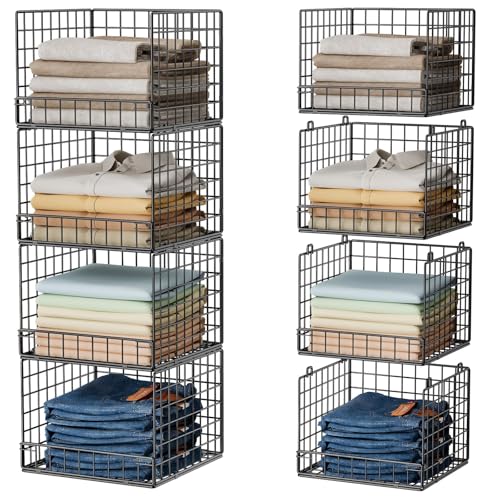
【Small Size】11.42"*11.22"*8.66"(W x D x H) in size, this small size shelf basket is suitable for most wardrobes, especially those with smaller compartment. Please check the dimensions carefully before purchasing to ensure it will fit.
11. Storage Behind the Bed

A headboard with built-in shelving puts folded sweaters and jeans within arm’s reach, but after two months the center shelf in mine became a graveyard for items I grabbed once and forgot. The brain treats anything behind a pillow as out of sight. The top 12 inches of any headboard shelf, the band your hand crosses without sitting up, is the only zone that stays in active use. Below that is storage theater: it looks organized until you need something.
The gap between a bed and the wall, usually six to eight inches, can fit a narrow floating ledge if the baseboard is low enough. I tried this with a 4-inch deep ledge and it worked for phone, book, and the next morning’s clothes laid flat, but anything folded taller than a single T-shirt stack tumbled into the crevice. Bed risers solve the under-mattress height problem for standard storage bins, though the platform grows wobbly past two inches of lift and the frame slides.
Under-mattress platforms with pull-out drawers need a bed designed for them; retrofitting a standard frame means the drawer front catches the bed skirt. Lidded containers protect against dust but add a motion, unlatching, that kills the habit of daily use. Open rolling drawers, the kind that slide like low-profile cubes, work better for gym clothes and shoes you reach for multiple times a week.
Opt for containers with lids to protect your garments from dust and ensure their longevity.
The lid advice is sound for off-season storage; for daily wear, the friction of opening it means clothes migrate back to the floor.
Platform beds with the drawer built into the frame eliminate the riser problem and the dust problem at once. The trade is mattress height: at 15 inches above the floor, climbing in feels like mounting a stage. For renters, a headboard shelf is the reversible choice; the platform bed is the commitment.
12. Built-In Custom Closet

Built-in custom closet systems turn a standard reach-in with a single rod and shelf into storage that handles everything a dresser used to. A mix of shelves for sweaters, rods for what you want hung, and drawers or bins for socks and small items keeps the full daily routine inside one space. Even a small closet can carry the load if you plan it around what you actually wear, not around closet rules about what should fold and what should hang.
The question for renters is whether to drill or go tension-mounted. Drilled systems hold more weight and stay level over time, but landlords notice holes at move-out; tension-mounted towers avoid that entirely and still come apart for the next apartment. I have watched enough lease-end inspections to know that spackle and touch-up paint rarely pass unnoticed if the holes are clustered in a wall, and some landlords charge for the repair regardless.
Cost reality: a modular system you install yourself runs a few hundred dollars for a reach-in closet, compared to custom built-ins that climb past a thousand. Thin hangers buy extra rod space, bins on upper shelves use height that otherwise goes empty, and a wire hamper built into the unit saves floor area. The trade-off is that tension systems can shift if you overload the shelves, so keep the heavy items low.
Declutter Before You Organize

The 80/20 rule hits hardest when every piece of clothing you own is visible at once. Spread it all across the bed and you’ll spot the jeans that haven’t fit in two years, the promotional t-shirt from a job you left, the three nearly identical black cardigans. Skip this step and you’re paying for storage real estate you’ll never use. I sort into keep, donate or sell, and occasionally mend, though the mend pile is where good intentions go to stall; set a two-week deadline or it becomes a third wardrobe you didn’t plan for. Bag the rejects the same day, before the "maybe" reflex sets in. The closet I organized last spring felt spacious only because I’d removed roughly a third of the volume first; hanging the remainder by category, work tops together and workout gear in its own zone, took ten minutes instead of an hour of shoving and reshuffling. Without that edit, even the cleverest rack or basket system chokes on sheer quantity.
Rotate Seasonal Clothing

The coat problem happened three Januarys ago. Summer sandals and linen shirts had gone into under-bed boxes in September, and the winter coats went right after them, but one box went farther back than the others. Label the short side you face when the bed is made, not the long side you see when you lift the mattress, because that orientation flips in your memory. Wheeled drawers slide out easier for the in-between seasons you do need occasionally; vacuum-sealed bags work better for the heavy puffy jackets, saving the inches that matter in a tight space. I missed that distinction once and spent a cold morning reaching into every corner under the frame.
Clear Bins and Visibility

Clear bins remove the step between remembering where something is and actually finding it. A few years into living without a dresser, I tried the tidy look of matching opaque containers under the bed, each labeled with a printed tag. The labels peeled. I stopped relabeling. One bin held swimsuits in November and sweaters in July because I never bothered to check.
Switched to 16-quart transparent lidded bins, the kind that slide flat on carpet, and the maintenance problem mostly solved itself. I can see the denim stack or the folded flannel without unstacking anything. The same logic applies to closet shelves and wire racks: a clear front panel beats a handwritten tag because the tag tells you what you wrote, not what is actually inside after three laundry cycles.
For daily-use items, open rolling drawers work without a lid entirely. For seasonal storage, a sealed clear bin with a snap-on top keeps dust out and lets you inventory in seconds. The only catch is that visible clutter still reads as clutter, so these work best tucked under furniture or turned so the contents face the wall.
DIY Storage From What You Own

The sturdiest project was two wood wine crates sanded and stacked, held together with nothing but four 1 1/4-inch wood screws through the sides. I set them in a corner for folded jeans and sweaters, and the whole thing cost zero dollars and twenty minutes. It stayed upright for two years until I moved, never wobbling because the weight of the clothes did the work a level would have. A coat of leftover satin paint would have helped, but I never got to it, and raw pine yellowed slightly where sunlight hit.
Old trunks need one check before you load them: lift the lid and smell. Musty fabric lining will transfer to anything stored inside, so a sheet of plastic or even an old shower curtain laid across the bottom fixes what a full reline would cost. I have seen suitcases stacked two high work as a side table between a bed and a wall, out-of-season clothes on the bottom, current rotation on top. The wheels on modern luggage make this less stable than the flat-bottomed hard cases from the 1970s, so skip anything that rolls unless you chock it.
A bookshelf dragged in from another room needs no modification to hold baskets or folded stacks, but the fixed-height shelves are the reason most people abandon this. Boots need twelve inches; t-shirts need eight. The mismatched air gap above every stack is space you are not using. I added one horizontal dowel across the top of a cheap particleboard case and hung pants on S-hooks from it, which turned the dead zone above the highest shelf into the most reachable storage in the whole unit.
Vertical Space You Are Not Using

The six inches between your curtain rod and the ceiling is usually empty, and that gap costs you about a linear foot of hanging space per wall. I missed this for two years in my first apartment, stacking bins on the floor while the upper wall sat bare.
Drywall anchors rated for 50 pounds sound generous until you load a shelf with sweaters. The failure does not announce itself. Mine pulled out overnight, leaving a ragged hole and a pile of folded clothes. Studs sit 16 inches apart in most American framing, but that is a rule of thumb, not a guarantee. A good stud finder catches the edge, not the center, so I mark both sides and drill in the middle.
Hanging organizers clipped to a closet rod drop the usable zone to about 42 inches vertical. Over-door hooks add about 12 inches protrusion behind a standard door; check your clearance against the jamb. A fabric shoe organizer at $8.99 from Amazon gives ten compartments for socks or scarves, and the door still closes flat.
Ceiling hooks work if the item is less load than the fixture looks like it can hold. Rope and a basic clip can suspend out-of-season coats in an upper corner, but stud or joist contact is not optional there. That anchor turns a coat into a wrecking ball.
Frequently Asked Questions
What can I use instead of a dresser?
Freestanding wardrobes, wall-mounted hooks and pegboards, open shelving units, under-bed storage bins, over-the-door organizers, suitcases or trunks, and storage benches all replace dresser drawers. The article covers each option with specific product recommendations and measurements, such as shelf depths of at least twelve inches for folded clothes and velvet hangers that recover 30–40% more rod space than plastic ones.
How do I organize clothes without a dresser?
Mount hooks and pegboards at staggered heights so a coat, bag, and pants occupy the same six inches of wall. Use acrylic shelf dividers on open shelving to keep folded stacks upright, and assign specific pockets in over-the-door organizers with labels so they do not become junk drawers. Clear bins with snap-on lids let you inventory contents in seconds without unstacking.
How do I store seasonal clothing?
Rotate seasonal clothing by storing off-season items in under-bed bins or vacuum-sealed bags, keeping current-season pieces accessible. Label the short side of the bin that faces you when the bed is made, not the long side, because orientation flips in memory. Wheeled drawers slide out easier for in-between seasons you need occasionally; vacuum-sealed bags work better for heavy puffy jackets where every inch of space matters.
What is a capsule wardrobe?
A capsule wardrobe is a curated collection of about 30 to 40 versatile pieces, including tops, bottoms, dresses, outerwear, and shoes, that mix and match without demanding much storage space. The article notes that reducing to this level let one writer replace a dresser entirely with a single clothing rack and two wall hooks, and laundry got faster simply because there was less of it.